
Tsunami waves have hit nations across the Pacific as a major 8.8 magnitude earthquake occurred off Russia’s far east coast Wednesday local time, prompting millions of people to flee to higher ground. The waves first impacted Russia and Japan, followed by Hawaii, California, Oregon, Washington, and Alaska. Tsunami warnings and advisories remained in effect early Wednesday for Hawaii, California, and the rest of the US West Coast, with more waves expected.
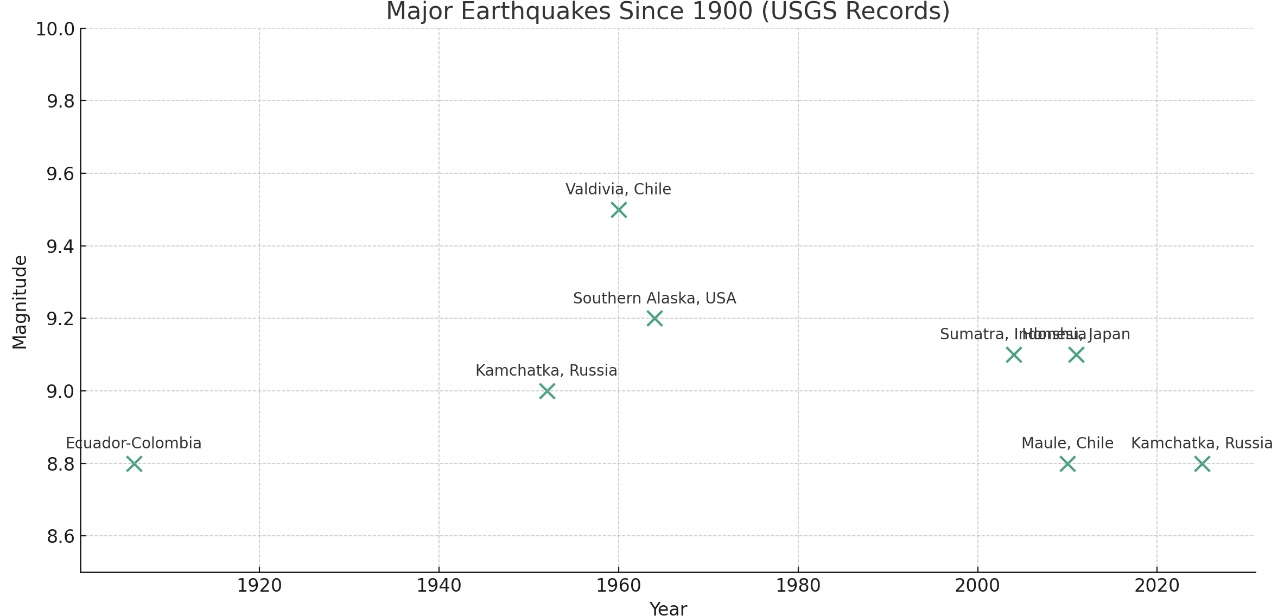
The Philippines, Indonesia, China, Chile, Peru, Mexico, Panama, French Polynesia’s Marquesas Islands, Papua New Guinea, Solomon Islands, Vanuatu, and Taiwan have all issued tsunami advisories, warnings, and watches, however several have subsequently been cancelled. The tremor off the shore of the Kamchatka Peninsula in far east Russia was the world’s biggest since 2011, when a 9.0 magnitude earthquake struck northeast Japan, causing a deadly tsunami. It is tied for the sixth strongest ever recorded.
It was too early to say how damaging any tsunami waves may be and initial impacts have been minimal.
8.8 earthquake off Russia coast triggers tsunami warnings in the Pacific
One of the largest earthquakes on record is triggering tsunami warnings across the Pacific, including for Hawaii and the US West Coast.
Earthquakes recorded 8.5 or higher on the Richter scale
Which areas may be affected?
The earthquake triggered tsunami alerts from Russia, in the eastern Pacific, to Ecuador and Chile, thousands of miles away across the Pacific Ocean.
As waves crashed onto Japan’s northern and eastern shores, more than 1.9 million people were ordered to evacuate. Tsunami warnings—the most severe sort of tsunami alert—were issued for Hawaii and the California coast from Cape Mendocino to the Oregon border. The warning for Hawaii was then downgraded to an advisory, a lower level of alert, and as of 11 p.m. HST on Tuesday (5 a.m. ET on Wednesday), the only tsunami warning in the United States remained in Northern California. Evacuations have been lifted on Oahu, the Hawaiian island that includes Honolulu.
Still, authorities there cautioned that risks continue. “Watch for floodwaters … do an assessment and check your structures and your homes,” James Barros, the administrator for the Hawaii Emergency Management Agency, said at a news conference.
Tsunami advisories are in place for the rest of the US west coast and Alaska’s Aleutian Islands, as well as British Columbia, Canada.
The governments of Chile, Peru and Ecuador also issued tsunami alerts. Ecuador’s Oceanographic and Antarctic Institute said the Galapagos Islands could see a wave measuring 1.4 meters (4.6 feet) by 9 a.m. local time.
The Integrated Tsunami Alert System of Mexico and Central America has issued a tsunami warning that extends from Ensenada, on Mexico’s northwest coast, to Panama. Advisories were also issued for many Pacific US territories, including Guam, the Northern Mariana Islands, and American Samoa.
Huge waves strike Hawaii.
As Hawaii readied for impact, Honolulu’s mayor, Rick Blangiardi, advised residents to seek higher ground. Sirens sounded around the city, and emergency shelters opened on the islands of Oahu, Kauai, and Maui.
“We ask people to remain calm but yet respond appropriately. If you can get to higher ground in a low-lying region, do so,” Rick Blangiardi said. The governor of Hawaii has ordered residents to leave coastal areas immediately. “It will not hit one beach, but will wrap around the islands,” stated Gov. Josh Green. Green encouraged citizens to evacuate coastal areas immediately during a news conference. According to National Oceanic and Atmospheric Administration data, the waves began to reach Hawaii’s coast in the early evening local time. According to the NOAA, a wave of over 5 feet was observed in Kahului, on Maui’s north-central shore.
After the first waves hit, Green said, “So far we have not seen a wave of consequence, which is a great relief to us.” He added that no damage had been reported so far, and there hasn’t yet been wave activity traveling past Hawaii’s Big Island.
Hotels along the west coast of Big Island were evacuating guests Tuesday evening local time. All flights in and out of Maui were canceled for the night, leaving about 200 people sheltering at the terminal, the governor said.
Japan’s northernmost island Hokkaido and sections of Russia were among the first to report tsunami waves of up to 60 centimetres (2 feet), prompting evacuations. Tsunami sirens may be heard wailing around the island on Wednesday morning. Reuters and the Nippon News Network posted video of people taking refuge on a roof.
More than 1.9 million people across Japan have been urged to move to safer ground, as waves up to 50 cm (1.6 feet) slap the country’s east coast, inching closer to Tokyo. That’s far below the initial forecast of up to 3 meters, though that could change, and additional waves could follow.
A tsunami wave measuring 1.3 meters (4.3 feet) was observed at Kuji Port in Iwate prefecture, northeastern Japan, according to the Japan Meteorological Agency, which added that tsunami waves were growing.
In the Russian district of Severo-Kurilsk, near the epicenter of the earthquake, a state of emergency was issued after tsunami waves lashed the coast, tearing boats from their moorings and carrying away storage containers, according to state media TASS and videos from the scene.


 English