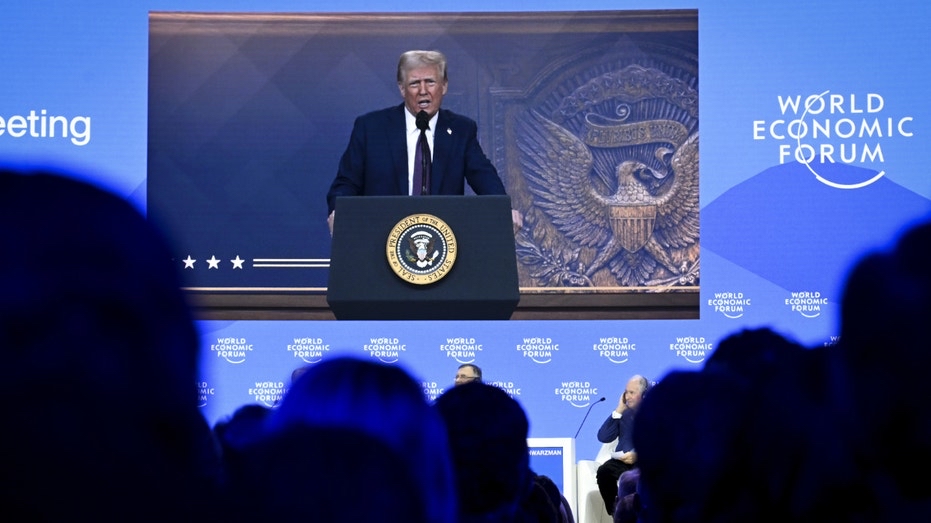
Speaking at the World Economic Forum on Wednesday, U.S. President Donald Trump renewed his controversial push for the United States to acquire Greenland, the vast Arctic island that is an autonomous territory of Denmark. Trump called for “immediate negotiations” over the territory but emphasized that the U.S. would not use military force to achieve this.
Addressing global political and business leaders at the annual summit in Davos, Trump framed his proposal as a matter of strategic security, noting Greenland’s location between North America, Russia, and China as making it invaluable for defense and global stability. He said that negotiations should begin immediately to discuss a potential transfer of sovereignty to the United States, adding that only the U.S. could adequately protect and develop the island.
Despite his suggestion that the U.S. could be “unstoppable” if it chose to use force, Trump repeatedly stressed that he “doesn’t have to use force, doesn’t want to, and won’t use force” to gain control of Greenland. Analysts noted that this is the first time Trump has explicitly ruled out military intervention, even as his earlier statements raised questions about the possibility of coercion.
Trump’s remarks sparked immediate backlash from Denmark, Greenland, and European allies. Officials in both Denmark and Greenland have insisted that the island is not for sale and reaffirmed Greenland’s sovereignty under the Kingdom of Denmark. European leaders criticized the proposal, with some describing it as a form of “new colonialism.” Trump’s prior threats to impose tariffs on NATO allies opposing the idea have added strain to transatlantic relations, raising concerns about broader diplomatic and trade consequences.
Greenland, rich in mineral resources such as rare earth elements, has long attracted U.S. attention for strategic and economic reasons. Trump has previously linked the idea of acquiring Greenland to national security and U.S. strength. Critics, however, argue that any attempt to transfer sovereignty would violate international law and undermine NATO cohesion, with several European governments expressing unified support for Denmark and Greenland’s right to self-determination.
It remains unclear how Denmark and Greenland will respond to Trump’s call for negotiations. Both have maintained that the island is not for sale, and many analysts suggest that any diplomatic engagement will likely focus on security cooperation and investment rather than a formal change in sovereignty. The situation continues to raise questions about NATO unity, Arctic security, U.S.–European trade relations, and Greenland’s political autonomy.


 English