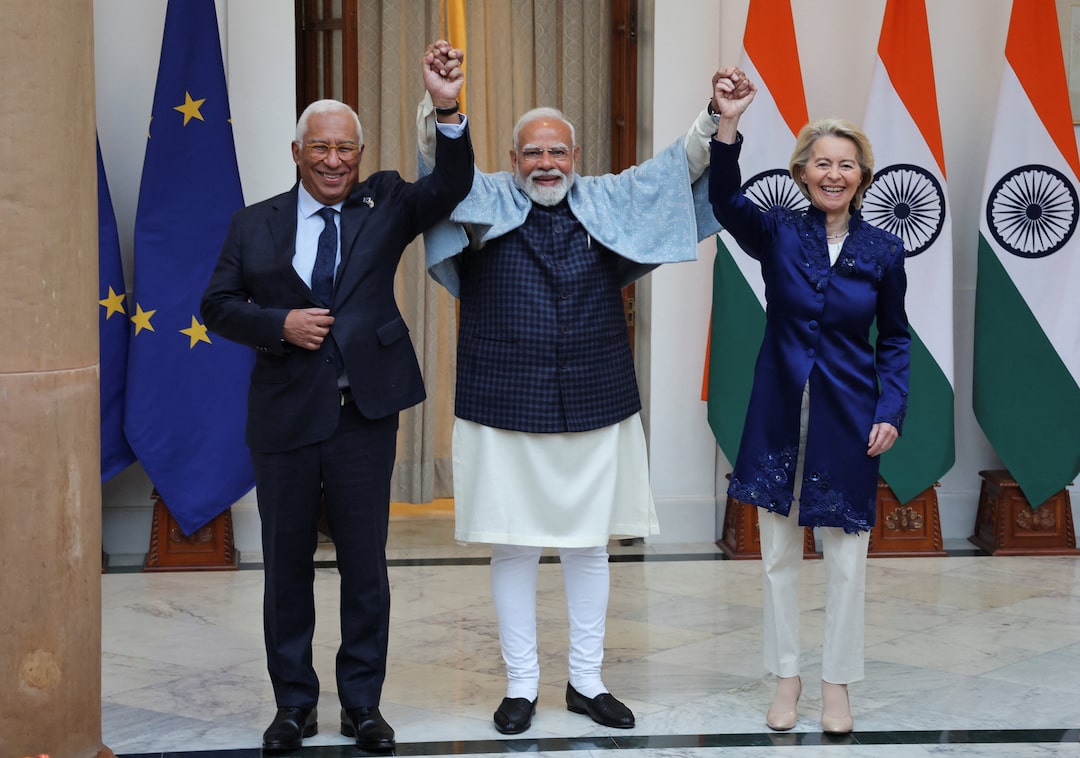
India and the European Union have announced a landmark free trade agreement, concluding nearly two decades of negotiations and creating one of the world’s largest economic partnerships. The deal was unveiled following high-level talks between Indian Prime Minister Narendra Modi and European Commission President Ursula von der Leyen, with leaders on both sides hailing it as a historic step that will deepen economic ties between the two regions and reshape global trade flows.
The agreement aims to significantly reduce or eliminate tariffs on the vast majority of goods traded between India and the EU, easing market access for exporters and manufacturers. European companies are expected to benefit from lower duties on products such as automobiles, wines and spirits, while Indian exporters are set to gain improved access for textiles, apparel, pharmaceuticals, leather goods and agricultural products. Alongside goods, the deal also addresses services, investment and regulatory cooperation, seeking to make it easier for businesses to operate across borders.
Officials say the pact will strengthen supply chains and boost trade and investment at a time of growing global uncertainty and geopolitical tensions. For the European Union, the deal offers a deeper foothold in one of the world’s fastest-growing major economies, while India sees it as a chance to expand exports, attract foreign investment and integrate more closely into global value chains. Economists estimate the agreement could substantially increase bilateral trade over the coming decade and generate significant savings in tariff costs for businesses.
Beyond economics, the deal is seen as strategically important, reflecting a shared interest in diversifying partnerships and reducing dependence on a narrow set of global markets. Leaders from both sides emphasized that the agreement reinforces their broader partnership on issues ranging from technology and sustainability to global governance.
The trade deal will now undergo legal review and ratification processes within the European Union, including approval by the European Parliament and member states, as well as formal procedures in India. Once completed, implementation is expected to begin within the next year, marking a new chapter in India-EU relations and setting a major precedent for future trade agreements.

 English