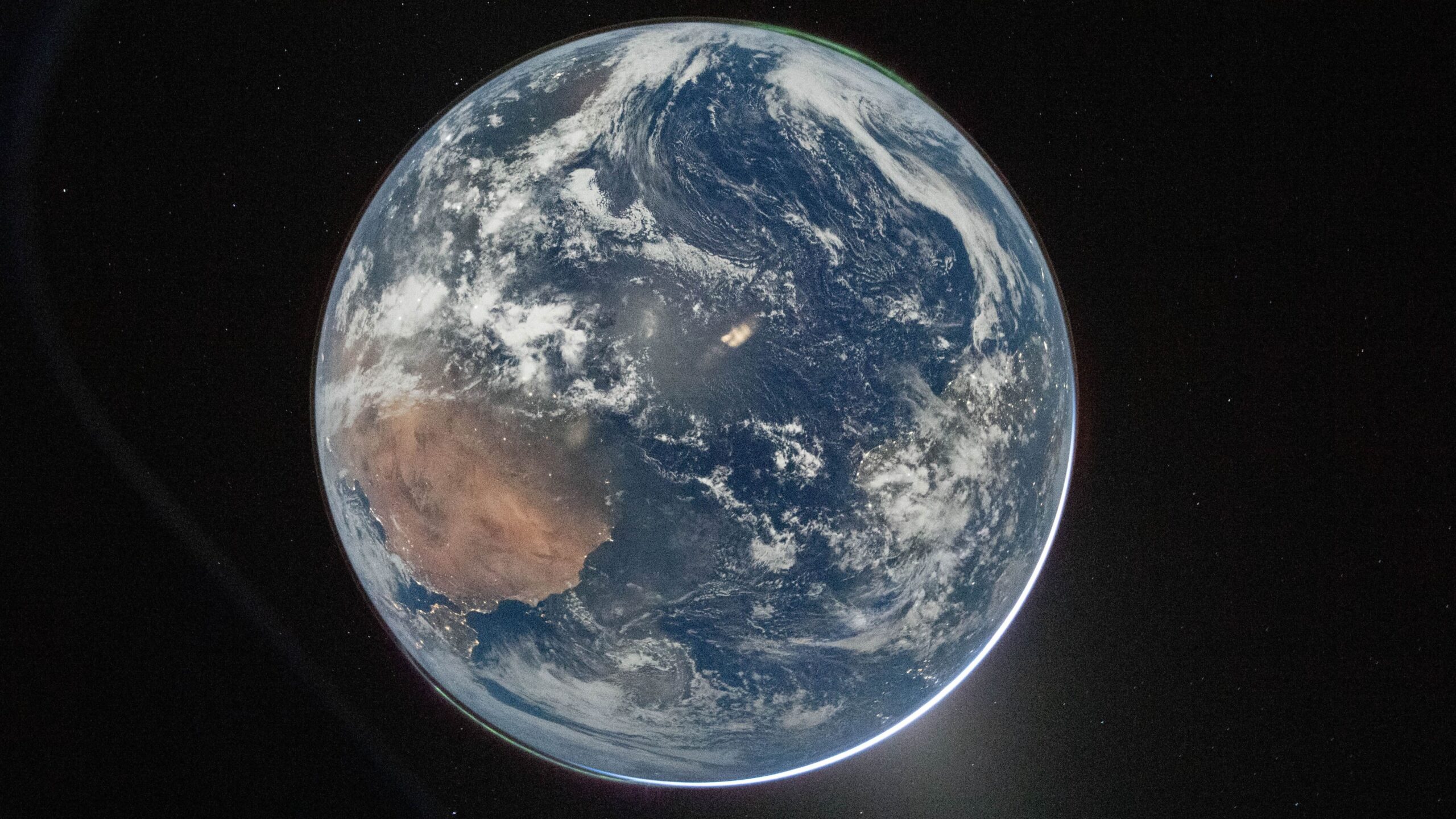
Astronauts aboard NASA’s Artemis II mission have reached a major milestone in their historic journey to the Moon, passing the halfway point and capturing striking images of Earth from deep space. The four-person crew—Reid Wiseman, Victor Glover, Christina Koch and Jeremy Hansen—are now traveling hundreds of thousands of miles from Earth aboard the Orion spacecraft, marking humanity’s first crewed mission beyond Earth’s orbit in more than five decades.
The mission, launched earlier this week from Kennedy Space Center, is following a “free-return” trajectory that will carry the spacecraft around the Moon and safely back to Earth without the need for additional propulsion. As of Saturday, the astronauts are closer to the Moon than to Earth, highlighting the scale and ambition of the journey.
During the voyage, the crew shared what they described as “spectacular” views of Earth, releasing photographs that show the planet as a vivid blue sphere against the blackness of space. Some images captured the so-called “terminator line,” where day meets night, along with glowing auroras visible from orbit—visuals that astronauts said emphasize both the beauty and fragility of the planet.
Commander Wiseman reportedly described the sight as breathtaking, while other crew members reflected on the sense of unity Earth presents when viewed from such a distance. The images, widely shared by NASA, have drawn global attention and renewed public interest in human space exploration.
Despite minor technical issues earlier in the mission, including a brief false alarm related to a cabin leak and a small onboard equipment malfunction, NASA confirmed that the spacecraft and crew remain in good condition. The Orion capsule continues to operate as expected as it travels deeper into cislunar space.
Artemis II is a 10-day test mission designed to evaluate spacecraft systems and astronaut performance in deep space, paving the way for future lunar landings later in the decade. The spacecraft is expected to fly around the Moon, traveling thousands of miles beyond its far side, before beginning its return journey and ultimately splashing down in the Pacific Ocean.
The mission represents a significant step in NASA’s broader Artemis program, which aims to establish a long-term human presence on the Moon and eventually support missions to Mars. For now, however, the crew’s images of Earth—described by observers as both “jaw-dropping” and symbolic—serve as a powerful reminder of humanity’s place in the universe as the astronauts continue their journey into deep space.



 English