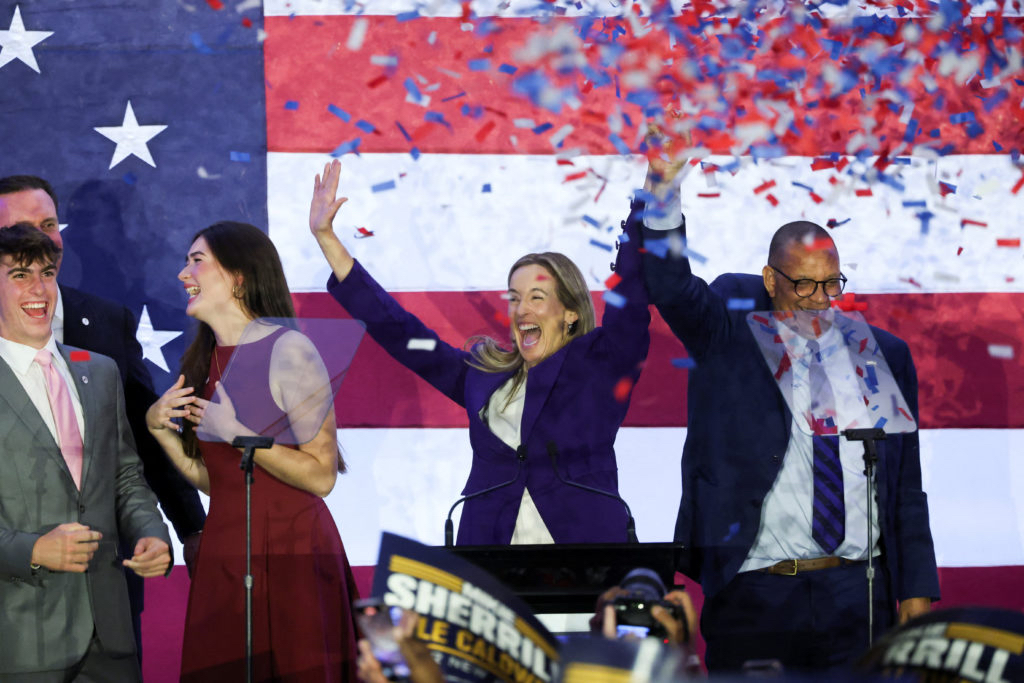
Democratic candidates scored decisive victories in a string of high-profile off-year contests Tuesday, delivering what party leaders called an early rebuke of President Donald Trump’s second-term agenda and giving Democrats momentum heading into the 2026 midterms. Wins in New York City, New Jersey and Virginia — together with a landmark redistricting ballot measure in California were characterized by analysts as a broad rejection of Trump-era policies and a warning shot to Republicans.
The most eye-catching result came in New York City, where 34-year-old progressive Zohran Mamdani won the mayor’s race, becoming the city’s first Muslim mayor and a symbolic victory for the party’s left flank. Mamdani’s upset over better-known opponents underscored an appetite among voters for new leadership in urban centers and injected fresh energy into progressive ranks.
In New Jersey, former congresswoman Mikie Sherrill held the governor’s mansion for the Democrats, defeating Republican Jack Ciattarelli in a race that national strategists watched as a test of suburban voters who swung toward Trump in 2024. And in Virginia, Abigail Spanberger captured the governor’s office while Democrats also prevailed in key statewide contests including attorney general and lieutenant governor — results that Democrats said reflected widespread disapproval of the president’s performance.
Voters in California approved Proposition 50, a controversial measure that temporarily shifts redistricting authority to the state legislature, a move Democrats framed as a response to Republican gerrymanders in other states and one that could allow Democrats to redraw district lines favorable to their party through 2030. The ballot’s passage drew sharp criticism from critics who said it undermines independent redistricting norms, but it was celebrated by Democratic leaders as a tool to blunt Republican advantages in future House battles.
Republicans and allies of the president sought to downplay the night’s results. Some GOP strategists attributed the losses to weak candidates or localized issues rather than a national swing; others warned that off-year electorates often favor the opposition party. White House reactions were terse and, in some instances, dismissive — reflecting a cautious tone as Republicans regroup after the setbacks.
Democratic leaders seized on the outcomes as evidence that their message centered on lowering costs for families, protecting democratic institutions, and distancing from perceived chaos in the White House resonated with voters. Senate Minority Leader Chuck Schumer declared the night “a repudiation of the Trump agenda,” while progressive organizers argued the victories showed that more ambitious proposals can win at the ballot box.
What it means going forward: strategists on both sides said Tuesday’s results will reshape 2026 planning. For Democrats, the victories provide fundraising and narrative advantages and may encourage a mix of moderate and progressive candidates to contest tough districts. For Republicans, the losses raise questions about candidate recruitment and messaging in a political environment in which the president remains a central and polarizing figure. Analysts emphasized that off-year results are not always predictive of midterm outcomes, but they noted the psychological and organizational boost a sweep provides to the party that benefits.
Election officials said there were no immediate, widespread reports of voting irregularities that would affect the results. With many contests now called, both parties are moving quickly to analyze precinct-level data and prepare for the 2026 cycle — a contest that will test whether Tuesday’s Democratic wave represents a durable shift or a temporary backlash.

 English