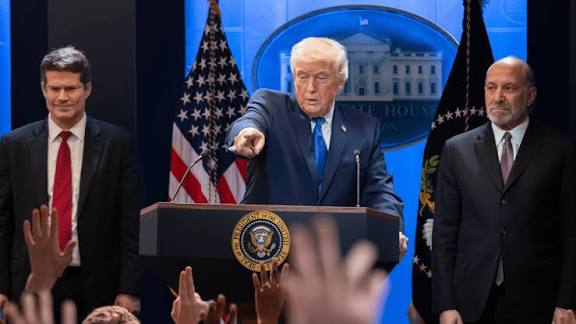
U.S. President Donald Trump said on Saturday that he will raise the global tariff rate on imports from the United States to 15 percent, just one day after the U.S. Supreme Court ruled that a major part of his previous tariff programme was unconstitutional. The court’s decision, issued in a 6–3 vote, found that Trump had exceeded his authority under the International Emergency Economic Powers Act, a 1977 law he had used to justify broad trade duties.
Trump’s announcement came in a Truth Social post, where he described the court’s ruling as “ridiculous” and “extraordinarily anti‑American” and said the increase to 15 percent would be effective immediately. He framed the move as legally permissible under a separate trade statute that allows temporary tariffs of up to 15 percent for a limited period while other legal avenues are explored.
The higher tariff rate replaces an earlier 10 percent global tariff that Trump had signed into effect on Friday after the Supreme Court setback. The original 10 percent duty was introduced under alternative legal authority following the ruling but was quickly superseded by the new 15 percent rate.
The Supreme Court decision was a significant legal rebuke to Trump’s use of emergency powers for trade policy, reaffirming that only Congress has broad authority to impose taxes and tariffs — a constitutional provision highlighted by the court’s majority opinion. Despite this, the president’s announcement showed he intends to continue using other statutory mechanisms to maintain trade pressure.
The reaction to Trump’s tariff increase has been mixed. Some supporters argue that higher tariffs are needed to protect U.S. industries and correct trade imbalances, while critics — including many economists and trading partners — warn that higher duties could raise costs for American consumers and disrupt global supply chains. Democrats in Congress have criticised the move, saying it risks hurting ordinary families and businesses.
Analysts also note the legal limitations of the temporary tariffs, which may expire after about 150 days unless Congress approves an extension, underscoring ongoing uncertainty over U.S. trade policy and executive power.

 English