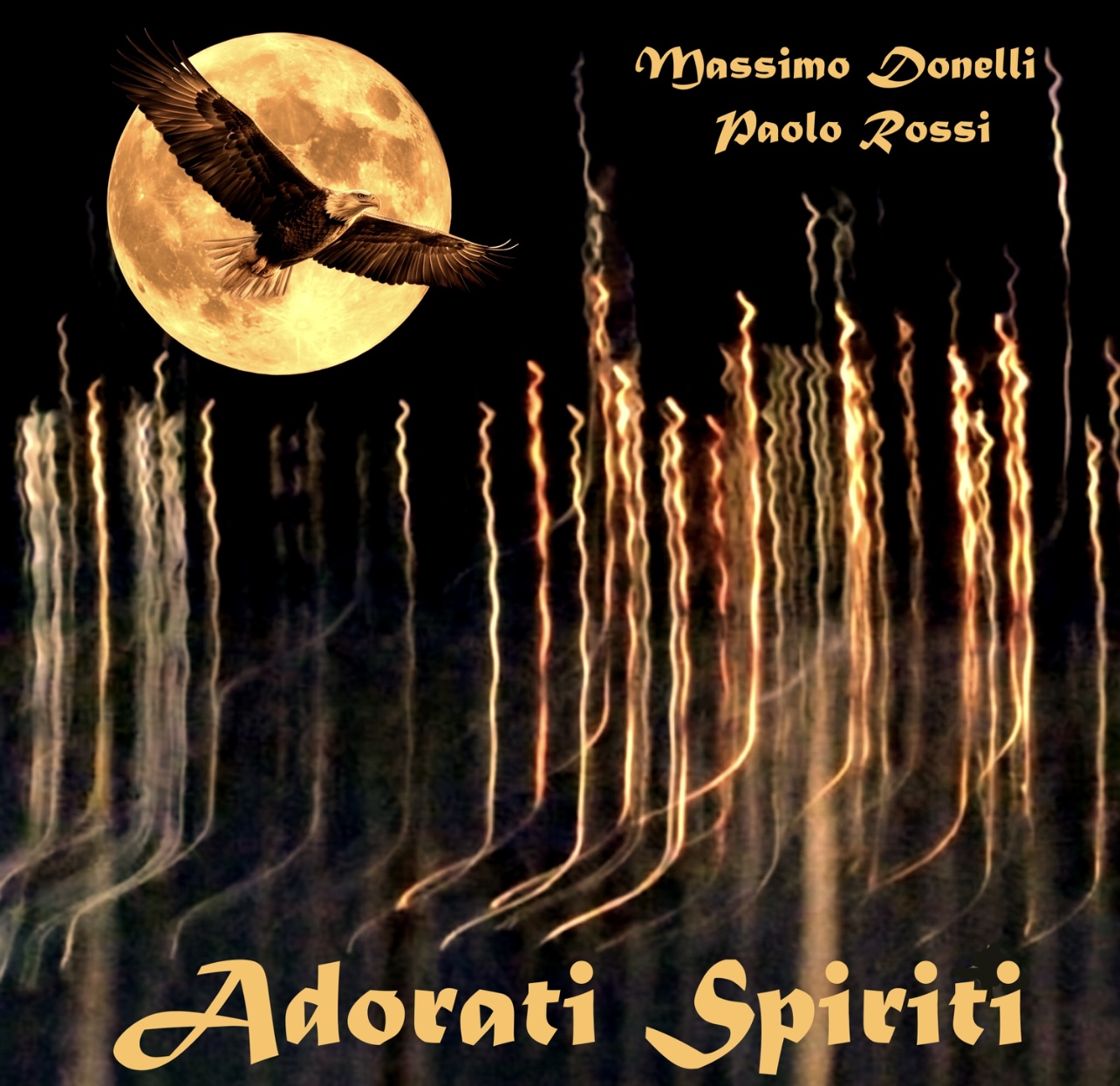
The poem “Adorati Spiriti” selects a particular story in order to raise a more general question concerning the role that established cultural, religious, social, and ideological benchmarks should play in a world that is changing rapidly; Massimo Donelli and Paolo Rossi examine this question through a concept involving the Native Americans from the Great Lakes area, the narrative point of view being that of Chayton and Tokala.
An old Cheyenne man named Chayton, who is approaching the end of his life, sees the younger generation growing up under entirely different conditions. Tokala has now become a part of a modern environment which is very different from the past, thereby bringing about a discussion regarding the principles which have shaped his people and whether or not those principles can still be significant.

Instead of giving a simple answer, the album presents the story in a way that shows the tension between continuity and change. Chayton does not urge Tokala to give up his current situation. On the last track, Tokala is encouraged to live freely and to accept what is new at the same time as acknowledging that an older set of principles can still remain alongside this freedom. It is this balance that gives the concept its broader outlook.
Donelli and Rossi tackle the project by combining composition, writing, and production, the musical influences in this case being mainly drawn from prog, jazz fusion and world music; Donelli is in charge of producing the music, which he later alters using artificial intelligence, while Rossi provides the lyrics and shares in the production duties. The album ‘Adorati Spiriti’ is conceived as an exploration of the way people cope with major cultural changes without simplifying a complex issue down to a straightforward choice between the past and the present.
Connect with MASSIMO DONELLI on FACEBOOK ,YOUTUBE ,SPOTIFY ,INSTAGRAM
 English